The Question
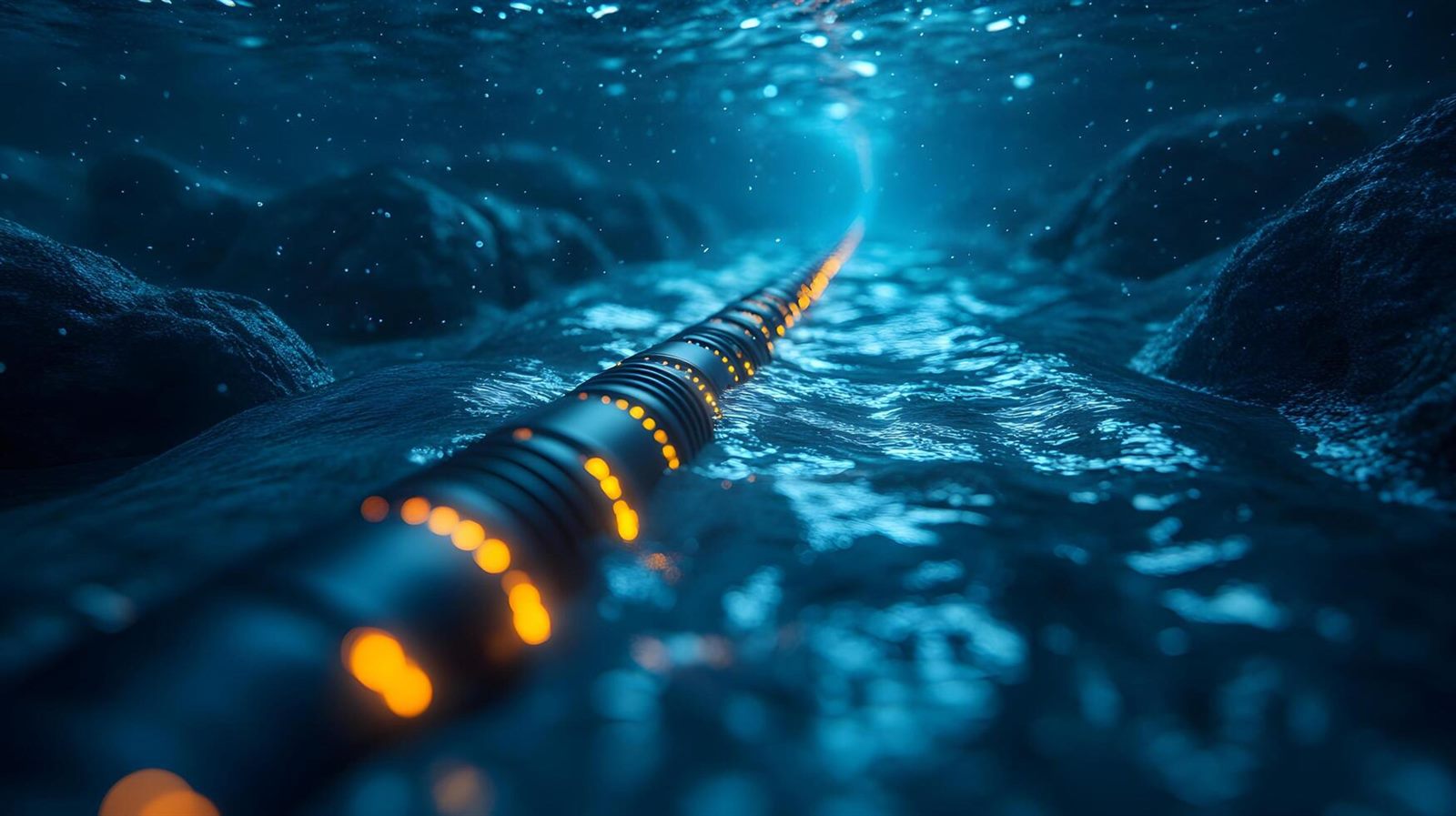
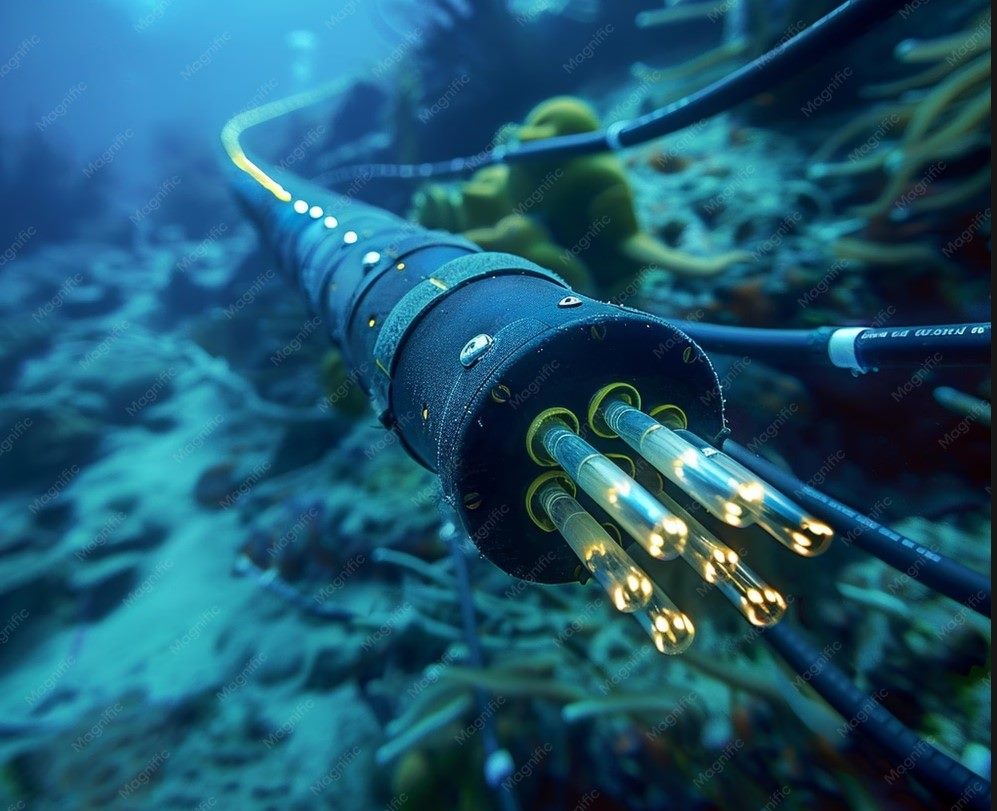
Look at a satellite dish and you might assume the internet lives in the sky. It does not. When you stream a film from another continent or wire money overseas, the data almost never goes up to space. It goes down — to the bottom of the ocean, into a bundle of glass fibres wrapped in steel and tar, laid across the seabed by ships that have been doing this quietly since the age of the telegraph.
The fact is startling once you sit with it. About 99% of the world's intercontinental data moves through roughly 500 to 600 submarine cables. In deep water, a cable can be as slim as a garden hose. Across those thin threads runs the machinery of modern civilisation: more than ten trillion dollars in financial transactions every single day, the entire global internet between continents, military communications, the lot. The question is no longer academic. As these cables are cut — sometimes by accident, increasingly by suspicion of sabotage — governments are asking a blunt question: who guards the strings the whole world hangs from?
What the Evidence Shows
Cables break constantly. The industry logs somewhere between 100 and 200 faults a year, and the great majority are mundane: a ship's anchor dragged across the seabed, a fishing trawler's net snagging a line, an undersea landslide. The system is built to cope. Traffic reroutes automatically, and specialised repair ships splice the break. Most of the time you never notice. That resilience is real — but it depends on there being enough spare cables and enough ships, and both assumptions are now under strain.
What changed the conversation was a run of incidents that looked less like accidents. In 2023, the Balticconnector gas pipeline and a nearby data cable in the Baltic Sea were damaged, with investigators pointing to a ship's dragging anchor. Through 2024, more Baltic cables were severed, and attention turned to a "shadow fleet" of ageing vessels whose anchors kept finding critical lines. In the Red Sea, cables were cut during the period of Houthi attacks on shipping, briefly degrading connectivity between Europe and Asia. And in 2022, a volcanic eruption near Tonga severed the island nation's single cable, cutting the country off from the internet for weeks — a stark demonstration of what one broken thread can do.
"We have built a global economy on a lattice of glass threads we cannot see and barely guard. An adversary does not need a missile to blind a continent. It needs an anchor and a plausible excuse."
— NATO Maritime Command — Critical Undersea Infrastructure Briefing, 2024The defenders are outnumbered. The worldwide fleet of cable-repair ships numbers only around 60 vessels, many of them decades old, and building or crewing new ones takes years. Satellite systems like Starlink can carry emergency traffic and reconnect a cut-off island, but they cannot come close to the sheer volume the seabed carries — the physics of radio simply does not scale to the internet's full weight. Meanwhile the landing stations where cables come ashore are themselves chokepoints: a handful of buildings on a handful of beaches, each one a single point of failure.
"An enemy no longer needs to cross your border. It only needs to drag an anchor across your ocean floor."
Why This Is Happening
The stakes finally became impossible to ignore. For decades, cables were treated as a private matter for telecom companies — laid, insured, and repaired quietly. The Baltic and Red Sea incidents dragged them onto the front page and into defense ministries. When ministers realised that a single ship could sever the nerves of the economy in international waters, cable protection stopped being a commercial footnote and became a security priority.
Deterrence is cheap for the attacker and expensive for the defender. Dropping an anchor "by accident" is deniable, low-cost, and hard to prosecute. Patrolling thousands of miles of open sea is none of those things. That asymmetry is exactly what pushes governments to formalise protection — sensor networks on the seabed, patrol patterns, and legal frameworks that turn a "dragged anchor" into an act with real consequences.
The military response is already taking shape. NATO has stood up a dedicated command to coordinate protection of undersea infrastructure, and individual nations are acting: the United Kingdom, for instance, brought a specialised surveillance ship into service to watch pipelines and cables. Once one alliance treats the seabed as a defended domain, others follow, because no major economy can afford to be the one that left its threads unguarded.
What Could Happen
Most major economies write undersea infrastructure into their defense doctrine. Navies run escort and patrol missions near critical routes, seabed sensor networks watch for approaching ships, and new repair vessels are commissioned. International talks begin on treaties that make deliberate cable cutting a defined hostile act. Protection becomes as normal as guarding an airport.
Instead of heavy militarisation, the world simply builds far more cables and repair ships, plus a stronger satellite backup layer. Cuts still happen, but so much slack exists that no single break matters. Defense stays involved but in a supporting role, and the crisis fades into an engineering problem rather than a strategic one.
Several cables are cut at once in a clearly deliberate strike, taking a region partly offline and shaking financial markets. Governments respond with rushed naval deployments, emergency spending, and open confrontation at sea. This is the alarming path — real, but less likely than the steady, deliberate build-up already under way.
What Can We Do
Most of this plays out at the level of navies and treaties, far above any individual. But the pressure to act, and the resilience of your own life, are things you can influence.
Understand your own dependence before a cut teaches you. Your bank, your employer, your medical records, and your government all rely on data crossing the ocean. Knowing that a single physical thread underlies "the cloud" changes how you think about backups, cash reserves, and local alternatives. Resilience starts with not assuming the connection is magic.
Back investment in redundancy, not just security theatre. The cheapest protection is more cables, more repair ships, and more diverse routes — so that no single cut matters. When infrastructure spending is debated, support the unglamorous line items: spare capacity and repair fleets do more for safety than a photogenic patrol boat.
Push for clear international rules on undersea sabotage. Right now, cutting a cable in international waters sits in a legal grey zone. Tell representatives you want treaties that define deliberate damage as a hostile act with real penalties. Clear rules deter the "accidental" anchor far more effectively than ambiguity does.
Keep an offline fallback for the essentials. If your region depends on one or two cables, an outage can last days. Keep some cash, downloaded documents, and a plan for communicating locally. It is not paranoia; it is the same common sense that keeps a torch in a drawer for a power cut.
- International Cable Protection Committee — Global Fault Statistics, 2024
- NATO Maritime Command — Critical Undersea Infrastructure Briefing, 2024
- TeleGeography — Submarine Cable Map and Industry Report, 2025
- UK Ministry of Defence — RFA Proteus Deployment Statement, 2023
- University of the South Pacific — Tonga Connectivity Impact Study, 2022
- Forecast The World Research Desk — 800+ data sources