The Question
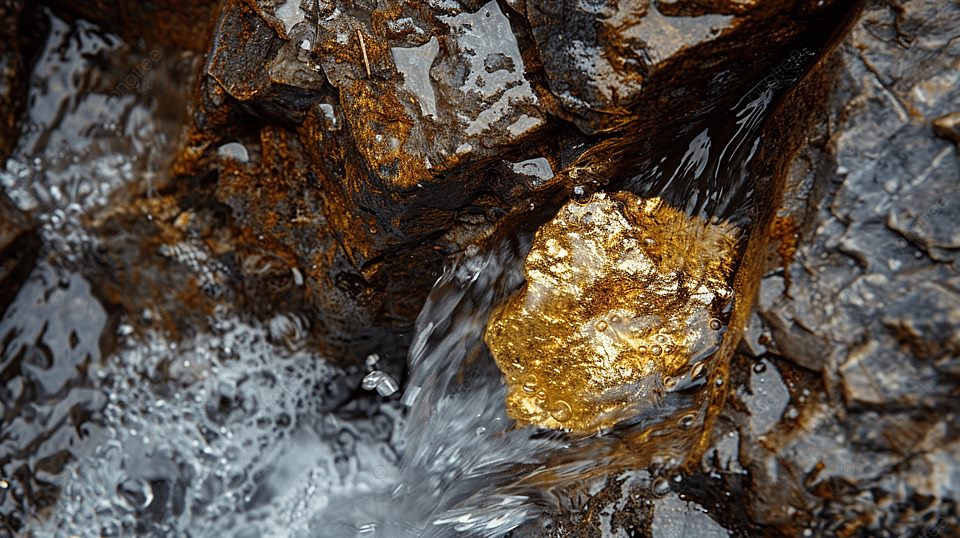
The arithmetic is real and the temptation is ancient. Chemists estimate the world's oceans contain something like 20 million tonnes of gold dissolved in the water, with far more locked in the seafloor beneath. Spread that across humanity and every person's share would indeed run into the millions of dollars. The phrase "enough gold to make everyone a millionaire" is not a lie. It is just a trap.
The problem is concentration. That gold is scattered so thinly — roughly one part per trillion — that you would have to process an almost unimaginable volume of water to collect a single ring's worth. The honest question is not whether the treasure exists. It plainly does. The question is whether any of the ocean's dissolved metals can ever be pulled out at a profit — and if so, which ones, and when.
What the Evidence Shows
History has already run this experiment. After World War I, the German chemist Fritz Haber — the same Nobel laureate who invented industrial fertilizer — spent years trying to extract gold from seawater to help pay his country's crushing war reparations. He built ships and refined his methods, and he failed completely. The gold was there, but it was too dilute to gather economically. A century of chemistry later, that verdict on gold still stands: pursuing it alone remains a losing bet, and any honest analyst will say so.
The interesting story lies with less glamorous elements. Seawater contains billions of tonnes of uranium — the fuel for nuclear power — at far more workable concentrations than gold. Researchers in Japan and at the United States' Oak Ridge National Laboratory have developed special plastic fibers, coated with a chemical called amidoxime, that soak up uranium as seawater flows past, like a sponge with a taste for one specific metal. The cost is not yet competitive with mined uranium, but it has fallen sharply and keeps improving.
"Gold in seawater is a parlor trick. Uranium and lithium are a supply chain. The future of ocean mineral extraction is boring, strategic elements — not the shiny one everyone asks about."
— Oak Ridge National Laboratory — Seawater Extraction Program Notes, 2024Lithium is the element that could tip the economics. The world needs enormous quantities of it for batteries, prices have been volatile, and land-based supplies are concentrated in a few countries. Companies are already extracting lithium from underground brines, and researchers are chasing membranes and adsorbents that could pull it from seawater too. Magnesium, meanwhile, has been commercially harvested from the ocean for decades — proof that seawater mining is not fantasy, just selective. The likeliest path forward is co-extraction: capturing valuable metals as a bonus from the vast streams of water that desalination plants already push through their systems.
"The ocean's real fortune was never the gold. It is the boring metals that build batteries and fuel reactors."
Why This Is Happening
The clean-energy transition has created ferocious demand for specific metals. Batteries need lithium; nuclear power needs uranium. Both are geographically concentrated and politically sensitive, so nations are hunting for alternative supplies. When a metal becomes strategically vital and land supplies look risky, even an expensive ocean source starts to look worth researching.
Adsorbent chemistry has quietly improved for decades. The amidoxime fibers that capture uranium, and the membranes being designed for lithium, are dramatically better than anything available in Haber's day. Each generation grabs more metal per gram and survives more cycles in seawater. Progress is incremental, but it compounds, slowly pushing costs toward the threshold of viability.
Desalination gives extraction a free ride. Water-scarce regions are building desalination plants that already pump colossal volumes of seawater and produce concentrated brine as waste. Pulling minerals from that brine turns a disposal problem into a revenue stream, sidestepping the biggest cost of ocean mining — moving the water — because someone else is moving it anyway.
What Could Happen
A company, likely piggybacking on desalination brine, demonstrates commercially meaningful recovery of lithium or uranium from seawater by 2035. It stays a niche complement to land mining rather than a replacement, but it proves the concept works at a real, revenue-generating scale for a strategically important metal.
Adsorbents keep improving and pilots multiply, but nothing crosses into profitable commercial production by 2035. Ocean extraction remains a well-funded laboratory promise, waiting on either higher metal prices or a further leap in materials before it becomes a business.
A venture markets the "gold in seawater" story to investors and, like Haber, collides with the same brutal dilution. Gold alone is almost certainly uneconomic at foreseeable prices, and any project built around it rather than uranium or lithium is far more likely to disappoint than to deliver.
What Can We Do
Ocean mineral extraction is a field where honest math is the best defense against both hype and dismissal. The treasure is real; the easy version is a mirage.
Distrust the "sea gold" pitch. If an investment or startup leads with the millions-of-tonnes-of-gold figure, treat it as a warning sign. Fritz Haber, one of history's great chemists, already proved that path fails. Serious ventures talk about lithium and uranium, not gold.
Follow the boring metals. The real progress is in uranium adsorbents and lithium membranes. Watch the work coming out of national laboratories and desalination projects; that is where a genuine breakthrough, if one comes, will actually appear.
Support extraction tied to desalination. The most economically honest version of ocean mining rides along with water treatment that is already happening. Backing research that turns brine waste into mineral recovery is far more grounded than funding standalone seawater-mining schemes.
Keep expectations proportionate. Even in the best case, the ocean supplements land mining rather than replacing it, and no one becomes a millionaire from seawater gold. Understanding that the fortune is diffuse and the practical prize is modest is the mark of a clear-eyed reader.
- Oak Ridge National Laboratory — Seawater Uranium Extraction Program, 2024
- Journal of Marine Chemistry — "Dissolved Metals in the World Ocean," 2023
- University of Tokyo — Amidoxime Adsorbent Field Trials, 2023
- International Energy Agency — Critical Minerals and Lithium Demand Outlook, 2025
- Science History Institute — "Fritz Haber and the Gold of the Sea," 2022
- Forecast The World Research Desk — 800+ data sources