The Question
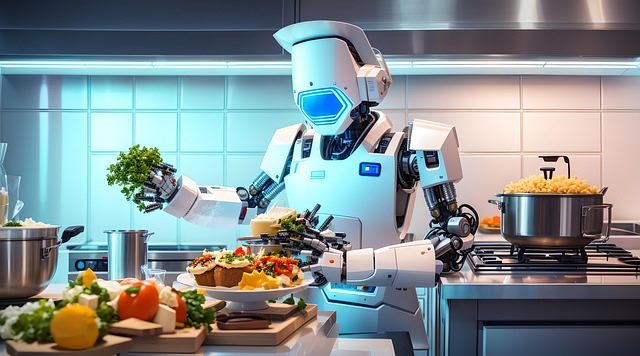
It is 5:40 on a Tuesday evening in 2032. You are still twenty minutes from home, tired, hungry, and completely uninvolved in what is happening in your kitchen. A machine on your counter has already dropped diced onions into hot oil. It stirs, tastes — yes, tastes, using sensors that measure salt and acidity — and adjusts. By the time your key hits the door, a chicken curry is resting, the rice is done, and the machine has begun washing its own pans. Nobody cooked. Everybody eats.
The strange thing about this scene is how little of it needs inventing. The luxury version already exists: Moley Robotics sells a robotic kitchen with two articulated arms that can prepare thousands of recipes — for upwards of $300,000, the Rolls-Royce of dinner. The question our forecast tackles is not whether machines can cook. They can. It is whether the price collapses the way every kitchen automation before it collapsed — and whether we will let go of the stove.
What the Evidence Shows
Semi-automation is already mainstream — you may just not call it that. The Thermomix, a countertop machine that weighs, chops, stirs, kneads, and cooks while walking you through recipes step by step, has sold millions of units and is a fixture of European kitchens; rivals like CookingPal do the same with a camera that recognises ingredients. These machines automate perhaps 70% of cooking. The remaining 30% — loading ingredients, moving pans — is an engineering problem, not a mystery.
Restaurants are the proving ground. Sweetgreen's Infinite Kitchen assembles salad bowls with almost no human hands, and the company reports its automated stores post higher margins and faster service. CaliExpress in Pasadena runs on burger-flipping and fry-cooking robots. Spyce — the robot restaurant founded by MIT graduates — was acquired by Sweetgreen precisely because its automated woks worked. Commercial kitchens are where dishwashing machines, microwaves, and refrigeration all proved themselves before shrinking into homes. The pattern is repeating on schedule.
"Nobody thought they needed a dishwasher either. The appliance industry's oldest lesson is that people do not want to automate cooking — right up until the machine exists, works, and costs less than a holiday. Then they cannot imagine life without it."
— Journal of Consumer Technology — "The Automated Home, Revisited," 2025The intelligence layer is arriving from another direction. Smart ovens like June and Samsung's AI models use cameras to recognise the dish you put in and cook it accordingly — no settings, no timers. Combine that recognition with the mechanical skills already proven in restaurant robots and the sensing already sold in countertop cookers, and the fully automated home meal stops being a moonshot. It becomes a packaging problem: getting the pieces into one box at one believable price.
"Your grandmother said a machine would never wash dishes properly. Your children will say the same thing about dinner — from the sofa, while the kitchen cooks."
Why This Is Happening
The economics of the evening meal are broken. The average household spends nearly an hour a day preparing food and cleaning up after it — the largest block of unpaid work left in modern life after childcare. Meanwhile delivery apps have trained a generation to pay a premium to avoid cooking, proving the willingness to pay exists. An appliance that cooks real food for the price of eighteen months of takeaway is not a gadget. It is arbitrage.
Robot costs are falling off a cliff. The robotic arms, cameras, and AI chips inside a Moley kitchen are the same components pouring out of factories for warehouses and cars, and their prices have dropped dramatically each product generation. The $300,000 showpiece of today is the demonstration model, the way the $10,000 flat-screen TV of 1999 became the $300 TV of 2015.
The people who need it most are multiplying. Ageing populations mean millions of elderly people who want to live independently but struggle to cook safely. Disabled users, shift workers, and exhausted parents form an enormous first market that does not care about culinary romance — they care about a hot, healthy meal appearing reliably. Healthcare systems, desperate to keep the elderly out of care homes, may end up subsidising the machines.
What Could Happen
Countertop units capable of complete meals — loading pre-portioned ingredients, cooking, and self-cleaning — cross below $2,000 by 2030 and into mass adoption by 2032. Supermarkets sell machine-ready ingredient kits the way they sell dishwasher tablets. Weeknight cooking becomes optional; weekend cooking becomes a hobby, like baking bread after the bread machine.
Full autonomy proves stubbornly expensive because handling raw, irregular ingredients is the hardest problem in robotics. The market matures around powerful semi-automatic machines — Thermomix descendants with cameras and self-stirring everything — that still need a human to load and unload. Ninety percent of the labour disappears, but "the kitchen cooked dinner" remains marketing rather than fact until the late 2030s.
Cooking's identity as love, therapy, and heritage proves stronger than convenience. Machines are seen as making "hospital food at home," early models disappoint on taste, and the category joins the bread machine in the cupboard of abandoned appliances. Automated cooking thrives only in institutions — hospitals, care homes, canteens — while home kitchens stay human.
What Can We Do
You do not need to wait for the full robot to start banking the benefits — and if the forecast holds, a little preparation now pays off in reclaimed evenings later.
Automate the worst half of cooking today. A multi-cooker or a guided machine like a Thermomix already eliminates the watching, stirring, and timing that make weeknight cooking exhausting. Households that adopt them report cooking more real food, not less — automation tends to replace takeaway, not home cooking.
Keep the skill, change its job. When machines take the weeknights, cooking becomes what gardening became after farming: a chosen pleasure. Protect one meal a week — cook it yourself, with the people you feed. The families that navigate this best will treat cooking as culture, not chore.
If you care for an elderly relative, watch this category closely. An automated meal machine may delay a move into residential care by years. Ask about ingredient-kit services and machine-compatible meal plans as they launch — the independence dividend is the most underrated part of this forecast.
Watch the ingredient-kit supply chain for the investment signal. The machines will be commodities; the recurring revenue is in the pre-portioned kits they cook. When a major supermarket chain launches machine-ready kits, the mainstream moment is roughly two years away.
- Moley Robotics — Robotic Kitchen Technical Specifications, 2024
- Sweetgreen — Infinite Kitchen Performance Disclosures, Investor Reports 2024–2025
- Vorwerk — Thermomix Global Sales and Household Penetration Data, 2024
- International Federation of Robotics — Service Robot Cost Trend Report, 2025
- Journal of Consumer Technology — "The Automated Home, Revisited," 2025
- Forecast The World Research Desk — 800+ data sources