The Question
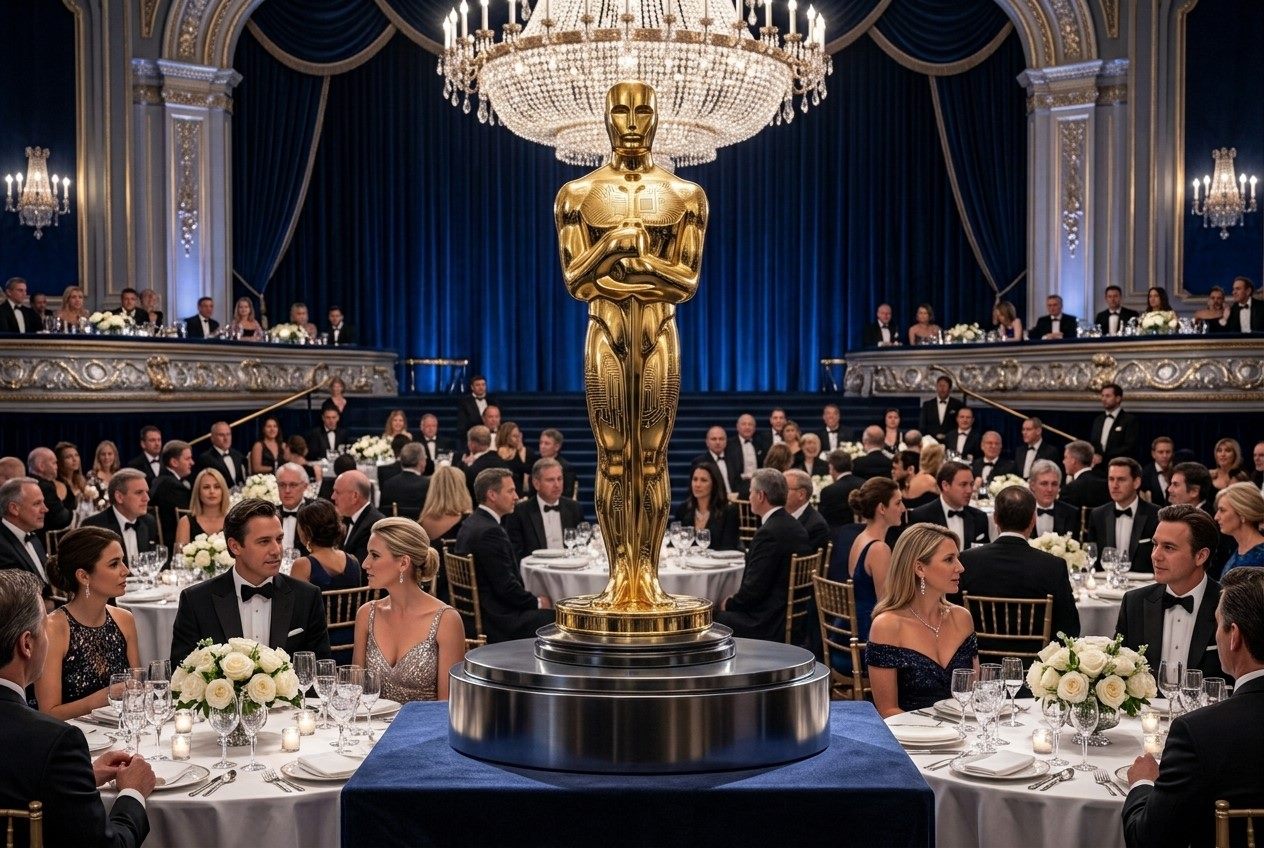
Awards season used to argue about performances and politics. Now it argues about pipelines. When it emerged that The Brutalist had used AI to refine Hungarian dialogue, and that Emilia Pérez had leaned on AI-assisted vocals, the conversation stopped being about the films and started being about the tools. Voters were suddenly asking a question the ballot never anticipated: how much machine is too much before the trophy means something different?
So the question is not whether AI is coming to the movies — it is already threaded through editing suites, dubbing rooms, and visual-effects houses across every nominee. The question is whether the institutions that crown the year's best will build an explicit structure to handle it: a disclosure rule, a fenced-off category, a definition of authorship. We think one of the major awards does exactly that by 2032 — because pretending the machine isn't in the room is getting harder every ceremony.
What the Evidence Shows
The Academy has already moved once. Ahead of the 2025 ceremony it stated that the use of generative tools would "neither help nor harm" a film's chances, with recognition resting on human creative authorship being central to the work. That is not a neutral position; it is a temporary truce. It concedes that AI is present while refusing to say what happens when it becomes dominant. Truces like that survive only until the facts on the ground overwhelm them.
History says the Academy adapts when it must. It added Best Animated Feature in 2001 once animation could no longer be waved off as a niche. It floated a "popular film" category in 2018, then dropped it under backlash — proof the body will experiment, retreat, and try again under pressure. Meanwhile the wider ecosystem is already institutionalizing AI film: Runway's AI Film Festival hands out prizes for work made largely with generative tools, and the Grammys rewrote their rules to require meaningful human authorship for eligibility. The templates for how to regulate the machine already exist.
"An award is a definition of merit wearing a gown. The moment the tool can do the thing the award honors, the award must either redefine merit or admit it is honoring the tool. Neither the Oscars nor anyone else escapes that fork."
— Screen Culture Journal — "Authorship After the Model," 2025The pressure is unlikely to come first from the Academy itself. More probably a rival award or festival forces the issue — crowning an AI-heavy film openly, or launching a dedicated prize — and the Oscars respond rather than lead. That reactive posture is exactly why this sits at a coin flip. Institutions this old do change, but slowly, and often only after a smaller, nimbler competitor has already changed the conversation for them.
"What is authorship when the tool writes the scene, sings the song, and paints the frame — and a human only says yes?"
Why This Is Happening
The tools crossed from invisible to central. For years, technology in film hid backstage — color grading, sound mixing, digital cleanup. Nobody demanded a category for Photoshop. Generative AI is different because it now touches the creative heart: it writes dialogue, clones a singer's voice, and generates whole shots. When the machine moves from the toolbox to the authorship, the old assumption that tools are neutral collapses, and the rules must name what changed.
Disclosure is becoming unavoidable. Guilds, unions, and audiences increasingly want to know what was made by whom. Once a film openly credits AI in its pipeline, ballots cannot pretend ignorance. A disclosure requirement is the least disruptive path — it lets the award honor human work while acknowledging the machine — and it is the single most likely first formal structure to appear, precisely because it defers the hardest questions.
The guilds are pushing in both directions at once. Some members want AI walled off from serious categories to protect craft jobs; others, especially smaller creators, want it embraced as a democratizing tool that lets tiny teams compete with studios. That two-sided pressure makes total silence untenable. When constituencies pull hard from opposite ends, institutions usually respond with structure — rules, definitions, a category — rather than continued ambiguity.
What Could Happen
Rather than a shiny new "Best AI Film" trophy, the first formal move is a mandatory disclosure of AI use plus an eligibility standard that keeps human authorship central — echoing the Grammys. It may be the Oscars, or it may be a festival that beats them to it. Either way, by 2032 at least one major award has written AI explicitly into its rulebook, and thank-you speeches start naming the models the way they once named editors.
A dedicated AI film award — an expanded Runway-style festival or a tech-backed newcomer — gains genuine prestige, drawing the boldest AI-native filmmakers who feel unwelcome at the Oscars. The Academy dithers, and cultural gravity shifts partway toward the upstart. The old ceremony isn't dead, but it is visibly playing catch-up, honoring a definition of film the frontier has already left behind.
The Academy keeps its "neither helps nor harms" language indefinitely, treating AI like any other tool and declining to build any category or disclosure regime. Voters self-police, controversies flare each season, but no formal structure appears by 2032. This requires the institution to absorb rising pressure without cracking — possible, but the historical pattern of eventual adaptation argues against it.
What Can We Do
Whether you make films, vote on them, or just love watching them, the fight over authorship in the AI era is one you can engage with rather than merely observe.
Ask for disclosure, not bans. The most useful thing audiences and members can demand is transparency: tell us what the machine did. Knowing that a voice was cloned or a scene generated lets viewers judge for themselves, without pretending the tools can be uninvented. Push institutions toward honesty over prohibition.
Defend the human at the center. The value worth protecting is not the manual labor of every frame but the creative intent behind the work. Support standards that reward vision, choice, and responsibility — the human saying yes and no — rather than penalizing every use of a modern tool.
Watch the upstart festivals. If you want to see where cinema is heading, follow the AI film festivals and the small teams making feature-scale work with tiny budgets. That is the frontier the big awards will eventually be forced to reckon with, and it is thrilling to watch it form.
Separate the craft from the panic. Not every AI in a movie is a threat, and not every objection is Luddism. Learn what the tools actually do in editing, dubbing, and effects so you can argue about the real questions — authorship and consent — instead of a caricature of robots stealing Oscars.
- Academy of Motion Picture Arts and Sciences — 2025 Rule Updates
- The Hollywood Reporter — AI in The Brutalist and Emilia Pérez, 2025
- Recording Academy — Grammy AI Eligibility Rules, 2024
- Runway — AI Film Festival Overview, 2025
- Screen Culture Journal — "Authorship After the Model," 2025
- Forecast The World Research Desk — 800+ data sources