The Question
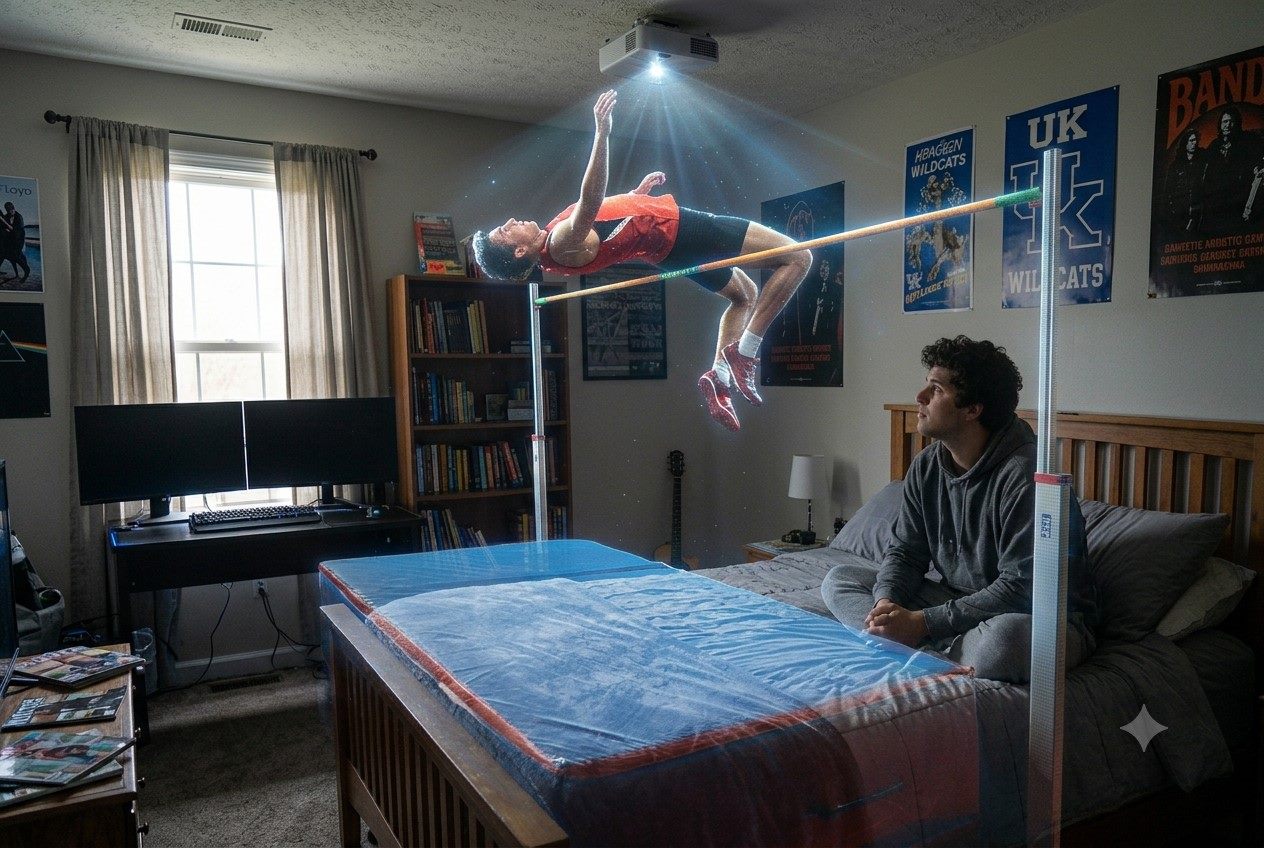
It is a Tuesday night in 2032. Your dad is in Chicago. You are in Madrid. And you are both sitting courtside at the same Bulls game — his knee brushing the scorer's table, your view perfectly aligned with the free-throw line, his voice in your ear as clearly as if he were on the next cushion. Neither of you paid for a flight. You each paid roughly what a movie ticket and popcorn cost, for a seat that physically does not exist.
That is the promise leagues and tech giants are now spending billions to keep. The question is not whether the technology can put you inside a game — it already can, in flashes. The question is whether virtual attendance graduates from novelty demo to a standard line on the ticket menu: bench, balcony, box, or beam-me-in.
What the Evidence Shows
The building blocks are stacking up fast. Apple's Vision Pro headset streams select NBA and MLS matches in immersive video so crisp that reviewers describe flinching when players dive for loose balls. Meta's Xtadium app and NBA partnership already sell virtual courtside positions inside Horizon, where fans watch live games from camera rigs mounted feet from the action. NextVR spent years pioneering live VR sports broadcasts before Apple quietly acquired it in 2020 — a signal of where Cupertino thought the puck was going.
Then there is the no-headset route. Cosm's "shared reality" domes in Los Angeles and Dallas wrap fans in an 87-foot LED screen — a mini-Sphere — so a crowd can watch an NBA playoff game as if seated inside the arena, beers in hand, no goggles required. Behind all of it sits volumetric capture: Intel's True View system once ringed stadiums with dozens of cameras to rebuild plays as 3D models you could spin like a video game replay, and Canon and Verizon now run similar rigs. Add 5G edge streaming to move those torrents of data in near real time, and the pipeline from court to couch is nearly complete.
"A physical courtside seat is the scarcest asset in sports — there are maybe a hundred of them in an NBA arena. A virtual courtside seat has infinite inventory. The league that figures out how to sell the same seat a million times will change the economics of live sport forever."
— Sports Business Review — "The Infinite Front Row," 2025The economics are the loudest argument. A real courtside seat can cost $5,000 on a good night. Sell a convincing virtual version of that same view for $50 to a million fans worldwide, and a single game generates more front-row revenue than a season of physical tickets. Leagues chasing global audiences — the NBA in Asia, the Premier League in America — see virtual attendance as a way to sell the in-arena feeling to fans who will never clear customs. The hurdles are just as real: headsets remain a minority purchase, motion sickness still ambushes some viewers, and beaming multi-camera volumetric video at broadcast quality devours bandwidth that even 5G strains to deliver.
"The best seat in the house is about to be in your house — if you can stand wearing the house on your face."
Why This Is Happening
Leagues have run out of physical seats to sell. Stadiums cap out around 20,000 to 80,000 fans, and the premium rows sold out decades ago. Meanwhile the NBA counts hundreds of millions of fans outside North America who will never attend a game. Virtual attendance is the only way to grow ticket revenue without pouring concrete, and league executives — watching media-rights money plateau — need exactly that kind of new line item.
The hardware is finally shrinking toward normal. The Vision Pro proved the picture quality; the next generation of headsets is racing toward glasses weight and mainstream prices, the same curve smartphones rode. Meanwhile Cosm's domes and hologram-projection research offer immersion without any headset at all — a hedge that means the forecast does not live or die on whether people tolerate goggles.
The social problem now has an answer. Sports are communal; headsets are solitary — that contradiction killed early VR sports. The fix arriving now is the shared virtual suite: private rooms where friends' avatars sit together, see the same play at the same instant, and hear each other groan. Meta and Apple are both building spatial-audio group viewing precisely because watching alone, however immersive, is not watching sports at all.
What Could Happen
The NBA leads, followed by football's Champions League and the NFL. Every major game offers a paid immersive option — headset courtside seats, shared virtual suites for groups, and dome venues in twenty cities for fans who want the crowd. Pricing settles between a stream and a stadium ticket. Physical attendance is untouched; virtual seats cannibalize couch-streaming, not the arena.
Headset adoption plateaus below the mass-market threshold, but Cosm-style shared-reality venues multiply — a night at the dome becomes the new sports bar. Immersive attendance is standard, just communal and out-of-home rather than in your living room. The league revenue arrives; the courtside-with-dad scene waits for lighter glasses.
Bandwidth costs, motion sickness, and simple habit keep immersive viewing a niche. Fans decide a 75-inch TV with friends beats a solitary headset, volumetric rigs stay a highlight-reel gimmick, and virtual tickets remain an experiment leagues quietly stop promoting — the 3D-TV story repeating itself.
What Can We Do

You do not need to buy anything today. But the fans who get the most from this shift will be the ones who sampled it early, priced it sensibly, and kept their real-world rituals intact.
Try before you buy — the demos are already live. If a friend owns a Vision Pro or Quest headset, borrow it for one immersive NBA game. Ten minutes will tell you more than any review about whether your stomach and your enthusiasm survive. If a Cosm dome opens near you, go once; it is the cheapest preview of the 2032 experience available.
Do not buy hardware for sports alone — yet. Today's headsets cover only a slice of each league's schedule, and rights deals shift yearly. Wait until your league guarantees immersive coverage of most games before spending headset money for sports reasons. The devices will be lighter and cheaper every season you wait.
Watch the ticket fine print as leagues experiment. Virtual seats will launch with wildly inconsistent pricing — some bundled into existing subscriptions, some sold as $99 one-offs. Compare against what you pay for streaming now, and remember the league's cost of an extra virtual seat is nearly zero. Early adopters who push back on pricing will shape it.
Protect the communal part on purpose. If you start attending virtually, do it with people — shared suites, watch parties, the dome with friends. The evidence is consistent: fans who watch socially stay fans; solitary viewers drift. The technology will happily isolate you if you let it. Don't.
- NBA & Meta — Xtadium and NBA in Horizon Partnership Reports, 2023–2025
- Apple — Vision Pro Immersive Video Sports Programming Notes, 2024–2025
- Cosm — Shared Reality Venue Attendance Data, Los Angeles & Dallas, 2025
- Sports Business Review — "The Infinite Front Row," 2025
- Verizon & Canon — Volumetric Capture and 5G Edge Streaming Trials, 2024
- Forecast The World Research Desk — 800+ data sources