The Question
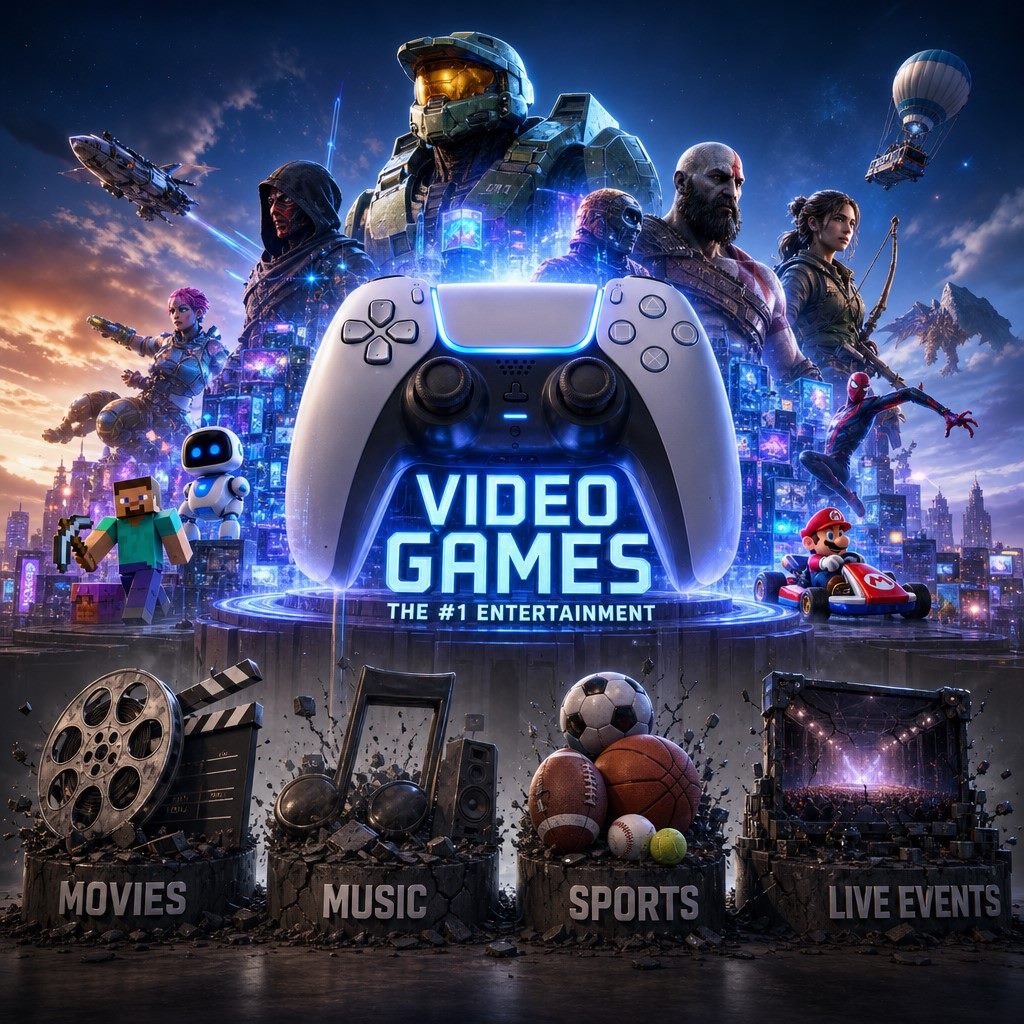
Ask a room of executives to name the world's biggest entertainment business and most will say Hollywood. They are off by a factor of five. Global box office brings in roughly $30 to $34 billion in a good year. Recorded music, about $28 billion. Gaming? Somewhere between $180 and $190 billion — and still climbing. The industry that parents once dismissed as a toy aisle has quietly lapped the field.
So the real question is no longer whether gaming can beat movies or music — it already has, decisively. The question is whether it can beat all of them at once: film, music, and the live sports business, stacked together. That is a taller order. It is also, on the current numbers, only a few years of ordinary growth away. And when it happens, the center of gravity of human entertainment will officially have moved from the screen you watch to the screen you play.
What the Evidence Shows
Start with the players: more than three billion people worldwide, nearly half of them women, with an average age around 35. This is not a niche of teenage boys; it is close to a majority of connected humanity. The engine is mobile — games on phones account for roughly half of all gaming revenue, reaching markets where a cinema ticket is a luxury but a phone is universal. In India, Brazil, and Southeast Asia, gaming is not competing with the movie theater. It arrived first.
Then look at where the money comes from. Modern hits are not products; they are places. Fortnite, Roblox, and Genshin Impact earn billions not by selling copies but by running live economies — skins, passes, events — that keep players spending for years. When Travis Scott performed inside Fortnite in 2020, over 12 million people attended a single show, and roughly 28 million joined across the event's run. No stadium in history comes close. Meanwhile the audience for watching other people play, on Twitch and YouTube Gaming, now rivals traditional sports viewership among people under 25.
"For anyone born after 2005, the game is not a break from social life — it is where social life happens. The living room, the playground, and the concert venue have all been rebuilt inside game engines, and the revenue is following the kids there."
— Digital Entertainment Quarterly — "The Third Place Goes Virtual," 2025The old guard has noticed. Microsoft paid $69 billion for Activision Blizzard in 2023 — the largest entertainment acquisition ever made, larger than Disney's purchases of Pixar, Marvel, and Lucasfilm combined. Netflix builds games. Sony's most valuable division is PlayStation, not pictures. Even sports leagues now run esports arms. When every legacy giant is buying its way into your industry, the argument about which industry is the future is effectively over.
"Hollywood spent a century teaching the world to watch. Gaming needed thirty years to teach the world it would rather play."
Why This Is Happening
Games swallowed the smartphone, and the smartphone swallowed the world. There are well over five billion smartphones on Earth, and every one of them is a game console. Mobile titles like Honor of Kings and Candy Crush earn more in a year than most film franchises earn in a decade. Movies need theaters and music needs catalogs; games only need the device already in your pocket. Distribution wars are usually won by whoever is closest to the customer, and nothing is closer than a phone.
Games monetize time, not tickets. A film earns from you once, for two hours. A live-service game earns from you for a thousand hours, in small voluntary payments, for years. The average dedicated player spends more per year inside their favorite game than a family spends on cinema outings. That difference — renting attention versus owning a habit — compounds season after season, and it is why gaming revenue grows even in years when box office shrinks.
Gaming became the social fabric of a generation. For millions of young people, Fortnite and Roblox are where they meet friends after school, attend concerts, and show off their style. The purchase of a $10 skin is less like buying a toy and more like buying clothes for a night out. When an industry becomes the venue for identity and friendship, spending stops being discretionary. Sports achieved this for the 20th century. Gaming is achieving it for the 21st.
What Could Happen
Gaming grows at a modest 6 to 8 percent a year, driven by mobile in emerging markets, live-service economies, and in-game advertising. Box office stays flat, recorded music grows slowly, and live sports grows on media rights but not fast enough. The lines cross before 2032, and gaming's roughly quarter-trillion-dollar total clears the combined bar. Culturally, the shift is already priced in: the biggest premiere of 2032 is a game season, not a film.
Streaming platforms bid league rights into the stratosphere — the NFL, Premier League, IPL, and NBA all land record deals — while gaming hits a saturation plateau in mature markets and regulators squeeze loot-box revenue in Europe and China. Gaming still wins, but the crossover slips two or three years, and sports remains the single most valuable live-broadcast product on Earth even after losing the aggregate race.
Governments treat in-game monetization the way they treat gambling: China-style playtime limits spread, loot boxes are banned across the EU, and app stores are forced to cap spending by minors. Combined with post-pandemic fatigue, gaming's growth drops toward zero while rivals hold steady. The combined crossover recedes beyond 2035. This requires coordinated regulation across every major market at once — history suggests the industry adapts faster than the law can aim.
What Can We Do
You do not have to love games to live in the world they are about to run. Whether you are a parent, an investor, or someone who still thinks of gaming as someone else's hobby, the smart move is to engage on your own terms.
Play something — seriously. If gaming is about to be the biggest cultural force on the planet, being fluent in it is basic literacy, the way knowing the big movies was in 1995. Try one acclaimed game a year. You will understand your kids, your junior colleagues, and the next decade of entertainment far better from inside than from headlines.
Parents: manage the wallet, not just the clock. The business model runs on small recurring purchases, and children are its most enthusiastic customers. Set app-store spending approvals, talk openly about how skins and battle passes are designed to tempt, and treat in-game money like real money — because it is.
Follow the money if you invest. The gaming economy now touches chipmakers, engine builders, phone platforms, and media giants. Understand where the growth actually sits — mobile, live services, emerging markets — rather than betting on nostalgia for console launches.
Push the industries you love to adapt, not sneer. Musicians who play in-game concerts, leagues that build playable versions of their sports, and studios that develop games alongside films are the ones thriving. If you work in entertainment, the question for every project after 2030 will be simple: can the audience play it?
- Newzoo — Global Games Market Report, 2025
- IFPI — Global Music Report, 2025
- Gower Street Analytics — Worldwide Box Office Review, 2025
- Microsoft — Activision Blizzard Acquisition Filings, 2023
- Digital Entertainment Quarterly — "The Third Place Goes Virtual," 2025
- Forecast The World Research Desk — 800+ data sources