What We Lost

Robert Putnam's "Bowling Alone" documented the collapse of community from 1960 to 2000 with a precision that remains unsettling. The neighbourhood — once the primary unit of social life, the place where you knew names, watched out for children, borrowed tools, and shared news — has been replaced by dispersed networks of friends connected by car and screen, and by homes designed as private fortresses rather than social nodes.
The average person spends 4.3 hours more alone per day than their equivalent in 1985. The home, once a place where visitors arrived and neighbours called round, has become a sealed unit of private consumption. We have optimised relentlessly for privacy and convenience, and arrived at isolation. The neighbour has become a stranger with a shared postcode.
The Evidence That It Matters
Research from Johns Hopkins shows that people who know their neighbours are 67% more likely to feel safe walking at night, significantly less likely to be burgled, and report markedly higher life satisfaction. The mechanism is not complicated: when you know the people around you, you notice when something is wrong. You watch out for each other's homes. You create, by knowing one another, a form of distributed security that no camera system can replicate.
Communities with high neighbour familiarity recover faster from natural disasters, have lower rates of depression, and show higher civic participation. When Hurricane Harvey hit Houston in 2017, the neighbourhoods that fared best were not the wealthiest — they were the ones where residents knew each other. People with names and relationships moved faster and more effectively than institutions. The street is not just a place. It is a public health intervention.
"Social cohesion at the neighbourhood level is one of the strongest predictors of community resilience and individual health outcomes we have ever measured."
Dr. Robert Sampson, Harvard University, Great American City, 2012The research on loneliness makes the case from another direction. The UK's own government-commissioned Murthy Report found that loneliness carries health risks equivalent to smoking 15 cigarettes a day. The neighbour — the person who can wave from a front garden, who notices you haven't collected your post, who knocks if something seems wrong — is one of the most accessible antidotes to chronic loneliness that most people have within 20 metres of their front door. Most people have simply never knocked.
"You don't need many neighbours. You need a few, and you need them to know your name."
Signs of Possible Revival
The signals of a neighbourhood revival are real, if still fragile. Nextdoor, the neighbourhood social network, has grown to over 80 million verified users in more than 11 countries — people who have chosen to connect with those living physically near them rather than only those they already know. The platform's growth suggests a latent appetite for local connection that social networks organised by friendship or interest have not satisfied.
The quiet rise of front-porch culture in new suburban developments is architecturally significant: homes being built with porches that face the street, with reduced front-garden setbacks, are not accidental design choices. They represent a deliberate attempt to rebuild the physical conditions that make spontaneous neighbour interaction possible. Walkable neighbourhood design has become a primary real estate value driver in most major markets — people are paying premiums to live in places where they might encounter their neighbours on foot.
Local WhatsApp groups and mutual aid networks that formed during the COVID-19 pandemic and never disbanded are another signal. In thousands of communities, the emergency that required knowing your neighbours produced connections that outlasted it. The people who met to organise food deliveries in March 2020 are still in contact. They know each other's names. The crisis created the introduction that normal life had failed to provide.
What Could Happen
Walkable design, shared digital tools, and deliberate community building produce a measurable increase in neighbour familiarity in most high-income urban areas. The revival is uneven — stronger in walkable cities and new developments, weaker in car-dependent suburbs — but the direction of travel is clear. Knowing your neighbours becomes a norm that younger generations actively pursue rather than passively inherit.
Car dependency, privacy preference, screen time, and the increasing privatisation of public space combine to prevent significant change. Nextdoor grows, but online neighbour connection substitutes for rather than builds toward in-person familiarity. Urban design improves in some areas but not at the scale needed to shift the baseline. Knowing your neighbours remains an aspiration rather than a norm.
Investment in car-free zones, play streets, local community platforms, and school ground transformation produces rapid, decisive reversal in specific cities — Amsterdam, Barcelona, Melbourne — that then becomes the template others follow. The model proves replicable and spreads faster than organic change would predict. Knowing your neighbours returns as a side-effect of cities being redesigned for people rather than cars.
What Can We Do
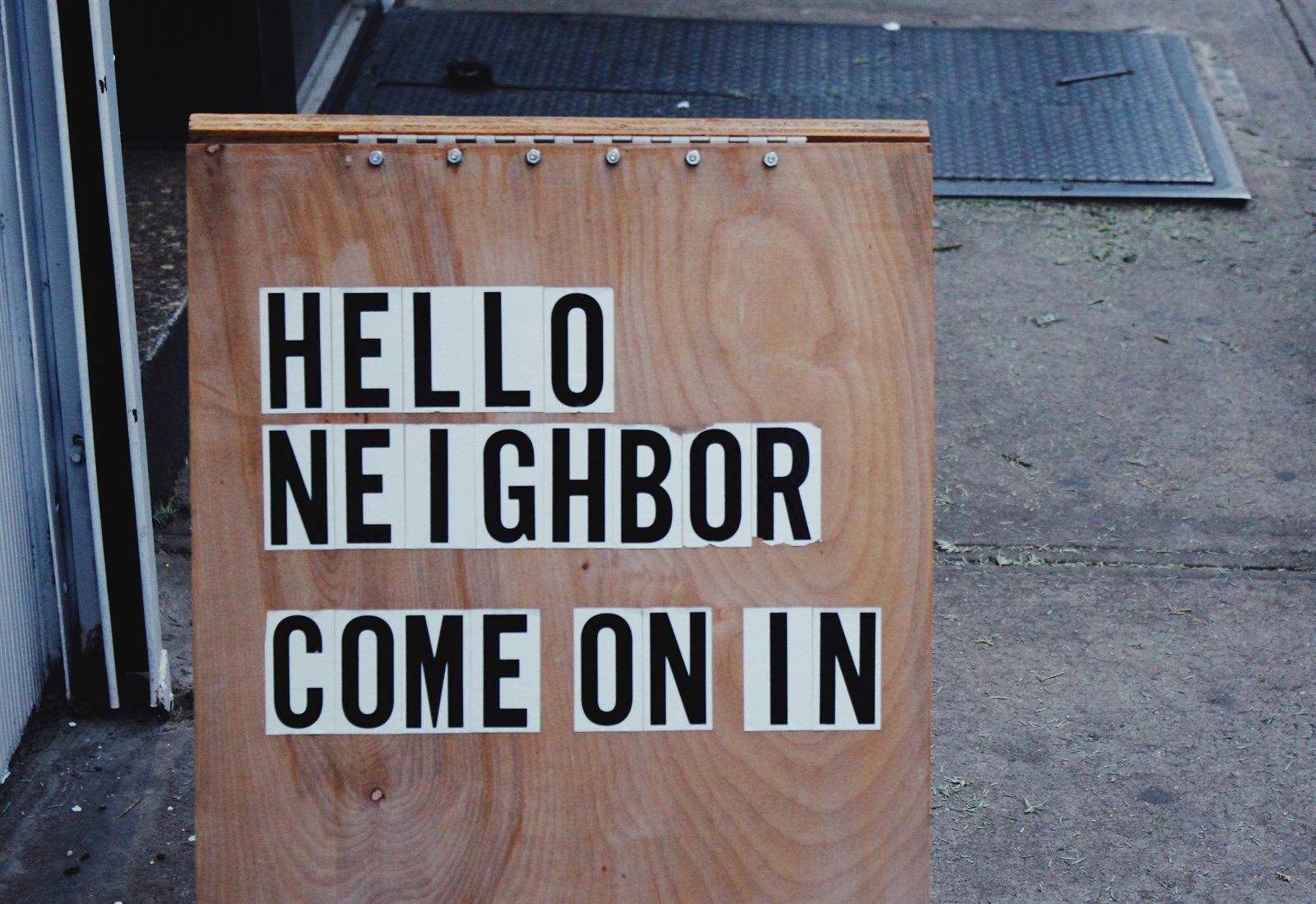
Learn your immediate neighbours' names this week. One door. One knock. One conversation. The research on what happens next is consistent: the first exchange is the hardest, and subsequent ones are progressively easier. You are not asking to become best friends. You are asking to be known. That is almost always reciprocated.
Host a block event — even a small one. A summer afternoon gathering, a shared garden clear-up, a street table for a sporting final. The mechanism matters less than the occasion it provides. Communities that have one annual shared event report dramatically higher rates of year-round neighbour familiarity than those that have none. The annual event is not the goal — it is the scaffold on which daily recognition is built.
If you move, choose walkability over space. The architecture of your neighbourhood shapes your social life more than almost any other variable. A house on a walkable street with a front garden and nearby amenities will produce more spontaneous social contact than a larger house in a car-dependent suburb. The extra square footage costs more in social capital than most people realise when they sign the papers.
- Putnam, R. — Bowling Alone: The Collapse and Revival of American Community, 2000
- Sampson, R. — Great American City: Chicago and the Enduring Neighbourhood Effect, 2012
- Johns Hopkins Bloomberg School of Public Health — Neighbourhood Social Cohesion and Health Outcomes, 2021
- Nextdoor — Annual Community Report, 2024
- Forecast The World Research Desk — 800+ data sources