The Question
How do wars like this actually end? The tidy answer is a peace treaty: leaders sign, borders are settled, armies go home. The untidy answer — the one history keeps giving — is that many wars simply stop. The shooting winds down along a line, the line grows fortifications, and decades later it is still there. Korea is the textbook case: the armistice signed on July 27, 1953 was meant as a temporary military arrangement, no peace treaty ever followed, and more than seventy years later the ceasefire line remains one of the most heavily guarded frontiers on Earth. Cyprus has lived with its Green Line since 1974. Kashmir's Line of Control has divided India and Pakistan for generations.
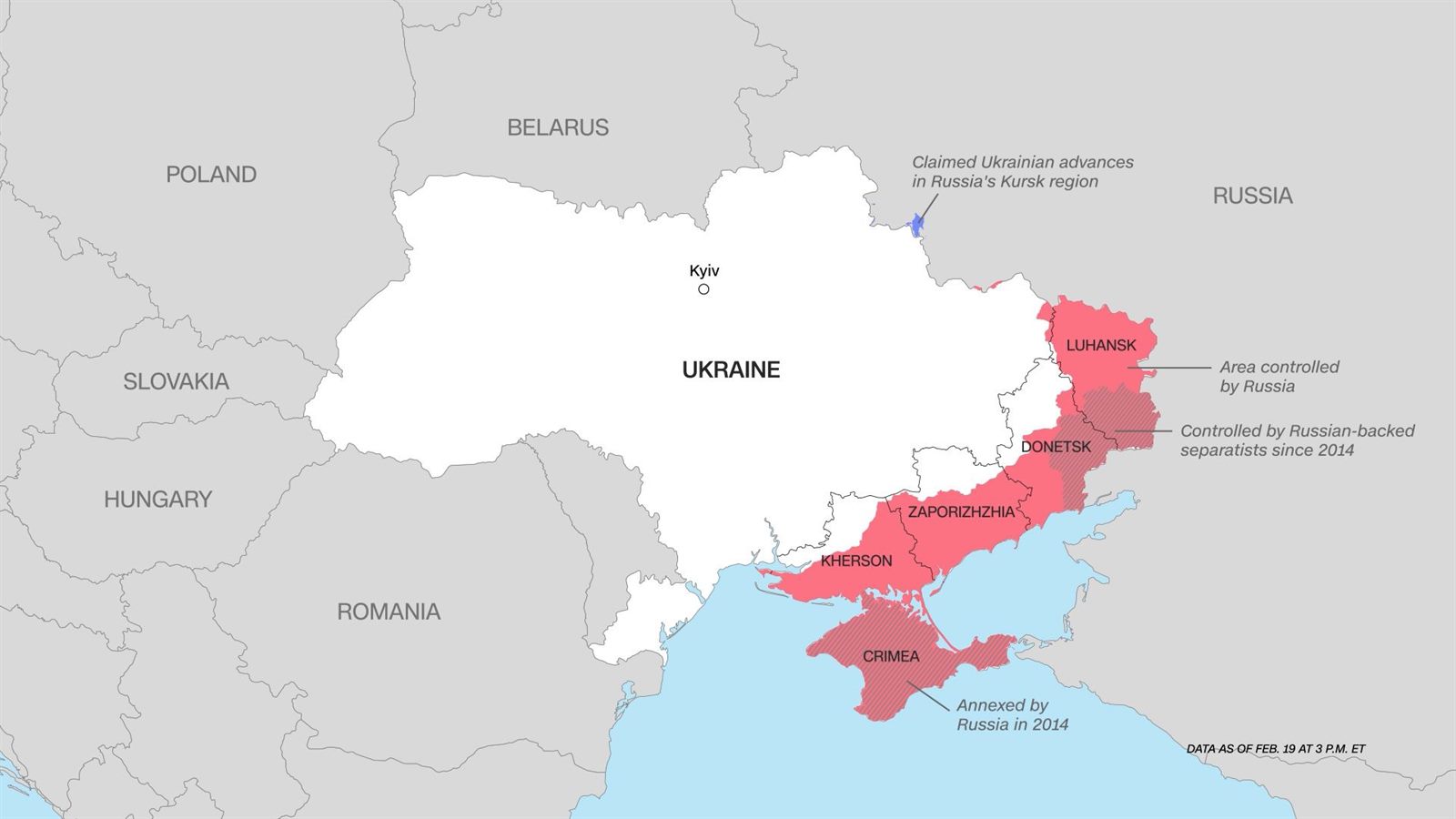
Ukraine now faces the same fork. Since late 2022 the war has been largely attritional — military shorthand for a contest of exhaustion, where the front moves slowly and every kilometer is paid for in lives and shells. Russia's advances through 2024 and 2025 gained ground, but at enormous cost. Neither side is close to total victory, and neither will concede defeat. The question this forecast answers: will the line where the armies finally stop become, in everything but law, the border of 2035? "De facto" is the key phrase — a border that exists in fact, in checkpoints and minefields and daily habits, whether or not any treaty ever blesses it.
What the Evidence Shows
Diplomacy is busier than at any point since the invasion, yet the space between a pause and a peace remains vast. In February 2026, US-brokered trilateral meetings convened in Geneva. An American goal of ending the war by June 2026 came and went unmet. What the process did deliver was real but limited: prisoner-of-war exchanges between April and June 2026, and short battlefield pauses around Orthodox Easter and Victory Day — humanitarian punctuation, not an ending.
June 2026 then brought a flurry of movement. On June 4, President Zelensky published an open letter to President Putin proposing an immediate ceasefire along the front line, direct talks, and an all-for-all prisoner exchange. On June 7, the United Kingdom, France, and Germany issued a joint statement backing direct dialogue, coordinated with Europe and the United States. On June 11, Russia's foreign ministry rejected the proposed conditions as unacceptable. The pattern is revealing: the two sides are now negotiating about how to negotiate — far more than existed in the war's early years, and still far short of peace.
"Every proposal now on the table starts from the same geography: the line of contact. What divides the parties is not where the fighting would stop, but what the stopping line would be allowed to become."
— UK House of Commons Library — Ukraine Peace Talks Briefing, 2026The sticking points are structural. Moscow demands all of the Donbas — including territory its army has never managed to take. Kyiv insists that talks proceed from the current line of contact and that any ceasefire come wrapped in Western security guarantees, the commitments meant to deter a third invasion. Russia rejects any Western troops on Ukrainian soil. Those positions rule out a peace treaty for now. Notice, though, what they do not rule out: an armistice that freezes the line while both sides keep their legal claims — precisely the arrangement Korea has lived under since 1953.
"Korea's 'temporary' armistice is now older than most of the people it divides. Temporary lines have a way of becoming permanent."
Why This Is Happening
Neither army can deliver a knockout blow. Four years of fighting have shown that drones, minefields, and dug-in defenses make large offensives ruinously expensive. Russia cannot conquer Ukraine; Ukraine cannot quickly retake all it has lost. When neither side can win outright and neither can afford to lose, wars drift toward the only outcome left — a stop line where the armies stand.
A treaty demands what neither government can give. A formal peace would require Kyiv to legally surrender territory or Moscow to formally hand it back — political suicide in either capital. A ceasefire asks for neither. It lets both sides stop the bleeding without signing away their claims, which is why exhausted combatants throughout history so often settle for one.
History supplies a ready-made template. Korea, Cyprus, and Kashmir all show that a monitored line, once quiet, develops its own inertia. Buffer zones and watchtowers accumulate, economies reorganize around the divide, and reopening the war comes to look worse than tolerating the line. Precedent guarantees nothing — but it marks the well-worn path of least resistance.
What Could Happen
Negotiations — perhaps after more failed rounds — eventually produce a ceasefire roughly along the line of contact, with monitoring, periodic violations, and no peace treaty. Ukraine never legally cedes territory; Russia never renounces its claims. By 2035 the line functions as a border in all but name, as Korea's has since 1953.
Diplomacy could reach further than an armistice: a package with security guarantees and phased arrangements that resembles a real settlement. Or the opposite — an early ceasefire fails, full-scale fighting resumes, and a new line freezes years later in a different place. Both variants still end at a negotiated line; they differ on when, and where it runs.
One side wins outright: Russian exhaustion and withdrawal restores Ukraine's internationally recognized borders, or a Russian breakthrough forces terms on Kyiv. Four years of attrition, fortified fronts, and mobilized defense industries all argue against a sudden knockout — though long wars can still surprise.
What Can We Do
No reader of this page will draw the ceasefire line. But the war's endgame will shape European security, defense budgets, and millions of lives — and how clearly citizens understand it matters.
Learn the difference between a ceasefire and a peace. When headlines announce a deal, ask which one it is. An armistice stops the shooting; it does not settle sovereignty, lift the threat, or end the era of sanctions and rearmament. Reading the fine print protects you from false hope and needless despair alike.
Keep humanitarian support flowing. Millions of Ukrainians remain displaced, and a frozen line will leave many unable to return home. Established relief organizations working with refugees and war-damaged communities will need support long after the guns quiet — recovery here will be measured in decades, not news cycles.
Follow the security-guarantee debate in your own country. Whatever guarantees anchor a ceasefire will bind real armies and real budgets, possibly yours. Whether you support or oppose such commitments, they deserve public scrutiny now, while they are being designed — not after they are invoked.
Treat battlefield claims with professional suspicion. Both sides wage an information war alongside the ground war. Rely on sources that show their evidence — independent conflict monitors, UN human rights reporting — and note who is making each claim before repeating it.
- UK House of Commons Library — Ukraine Peace Talks briefing (2026)
- Institute for the Study of War — battlefield assessments (2022–2026)
- UN Human Rights Monitoring Mission in Ukraine — reports (2022–2026)
- Korean War armistice records — US National Archives (1953)
- IISS — The Military Balance (2026)
- Forecast The World Research Desk — 800+ data sources