The Question
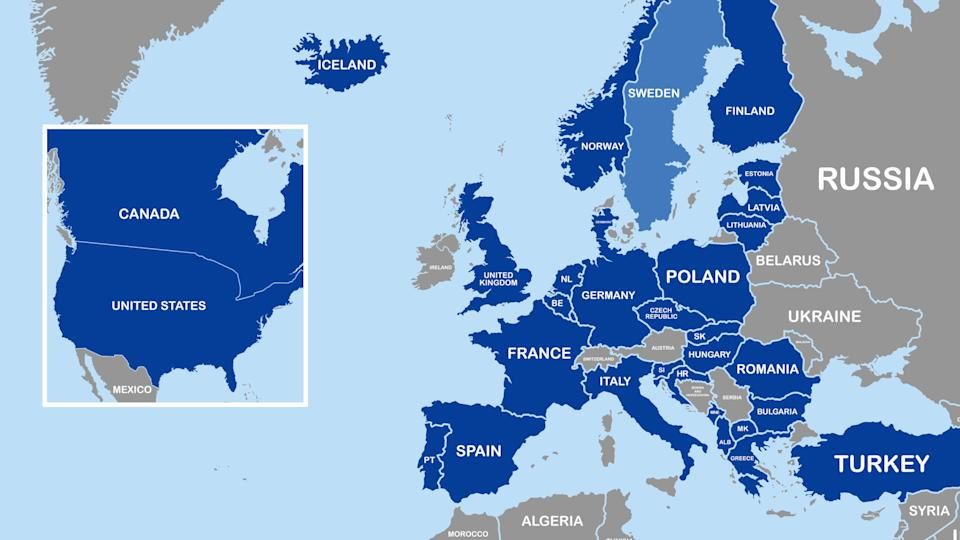
Article 5 is the heart of the North Atlantic Treaty, signed in Washington in 1949: an armed attack against one ally "shall be considered an attack against them all." It is often misread as an automatic declaration of war — in fact, each member decides for itself how to respond. Its power has always been psychological: any aggressor must assume it would face all 32 members, from the United States to the newest joiners, Finland (2023) and Sweden (2024). In three-quarters of a century it has been formally invoked once — on September 12, 2001, by America's allies, the day after the 9/11 attacks.
A guarantee that is never tested can look invincible. The danger of the 2020s is an adversary methodically probing where the guarantee begins — with attacks calibrated to hurt, but not to obviously qualify as an "armed attack." The question this forecast weighs: can an alliance built for invasions deter arson, sabotage, and deniable drones?
What the Evidence Shows
Since 2024, Western governments have attributed a widening campaign of sabotage across Europe to Russia. Warehouses linked to Ukraine-bound goods burned in Britain, Germany, and Poland. Incendiary parcels ignited at courier hubs. German authorities reportedly disrupted a 2024 plot against a defense-industry chief executive. GPS jamming — interference with the satellite navigation that airliners and ships rely on — became routine over the Baltic. And beneath the Baltic Sea, the Balticconnector gas pipeline was damaged in 2023, followed by a string of severed data and power cables in late 2024 and 2025, prompting NATO to launch "Baltic Sentry" patrols of ships and aircraft in January 2025 to watch over the seabed infrastructure.
Then the probing moved into NATO's skies. On the night of September 9–10, 2025, about 20 Russian drones crossed into Poland; NATO aircraft shot several down — the first time the alliance has kinetically engaged Russian military assets in its history. Days later, Russian MiG-31 jets spent roughly 12 minutes inside Estonian airspace. After each incident, allies invoked Article 4 — the treaty's lesser-known clause requiring consultations when any member feels its security threatened — a step taken only a handful of times in NATO's first seven decades, and repeatedly since 2022.
"The Parties agree that an armed attack against one or more of them in Europe or North America shall be considered an attack against them all."
— North Atlantic Treaty, Article 5, Washington, 1949The strain is not only external. During the 2024 US campaign, President Trump suggested he might not protect allies who "don't pay" — remarks he softened after allies agreed at the June 2025 Hague summit to spend 5% of GDP on defense. On the ground, deterrence is thickening: the eight multinational battlegroups stationed along NATO's eastern flank are scaling from battalions toward brigades, roughly 300,000 troops are assigned to higher readiness under the alliance's new force model, and Germany is stationing a permanent armored brigade in Lithuania — its first such foreign deployment since 1945 — to be fully in place by 2027.
"The attacks are engineered to be deniable, damaging, and just small enough that thirty-two capitals hesitate."
Why This Is Happening
Hybrid attacks exploit the treaty's seam. Article 5 speaks of an "armed attack" but never defines where sabotage, arson, or a cut cable falls. Every incident arrives wrapped in ambiguity — an anchor "accidentally" dragged across a cable, arsonists recruited anonymously online for cash — and collective action requires 32 governments to agree on who did it and what it merits. Attribution takes months; the attacker moves in days.
Russia seeks to weaken NATO without fighting it. With its ground forces committed in Ukraine, Moscow cannot win a conventional war against the alliance — Western intelligence agencies instead describe a cheap, deniable pressure campaign: impose costs on countries arming Ukraine, test reaction times, and map the alliance's political fault lines, all while insulating itself behind plausible deniability.
Credibility lives in perception, not on paper. Deterrence works only if an adversary believes the promise will be kept. Public doubts about American commitment, spending disputes, and slow responses to gray-zone incidents all feed the same calculation in Moscow. Every unanswered provocation teaches the attacker something about where the real red line sits — and invites a step further.
What Could Happen
Sabotage, jamming, and incursions continue or escalate, and NATO adapts in kind — more Baltic Sentry-style patrols, faster public attribution, routine shoot-downs of intruding drones, and quiet costs imposed on Russian operations. Article 4 is invoked often; Article 5 never is. Credibility bends without breaking.
A sabotage attack that kills civilians, or an air engagement that downs a manned aircraft, pushes a member to formally ask for collective defense. The alliance either responds visibly together — strengthening deterrence for a decade — or splits publicly, which is precisely the outcome the campaign is designed to produce.
Russia deliberately tests the treaty with a conventional strike or land grab, most plausibly in the Baltic region. This remains the least likely path while Russian forces are consumed in Ukraine — but it is the scenario NATO's entire eastern buildup exists to make unthinkable.
What Can We Do
Hybrid campaigns target societies more than armies — the cables, airports, and public opinion of ordinary countries. That makes citizens part of the defense, whether they choose to be or not.
Know Article 4 from Article 5. Article 4 means consultations; Article 5 means collective defense. Headlines routinely blur them, making every incident sound like the brink of war. Knowing the difference inoculates you against both panic and the cynical shrug — the two reactions these operations aim to produce.
Treat infrastructure disruption as part of the picture. A cable cut can slow your internet; GPS jamming can delay your flight; a drone sighting can close an airport. Basic household preparedness — and patience with disruptions — denies saboteurs the chaos they are purchasing.
Be a hard target for disinformation. Sabotage is usually accompanied by online campaigns pushing competing explanations and stoking blame between allies. Before sharing claims about who did what, wait for official attributions and check whether serious outlets on both sides of the Atlantic are reporting the same facts.
Reward measured firmness, not theatrics. The responses that work — documented attribution, collective patrols, proportionate costs — are undramatic by design. Support leaders who deliver them, and be skeptical of anyone selling either imminent doom or the claim that nothing is happening at all.
- NATO — North Atlantic Treaty (1949) and summit communiqués, 2024–2026
- RAND Corporation — Deterrence and hybrid-warfare studies, 2024–2025
- IISS — The Military Balance 2026
- CSIS — Hybrid-threat and undersea-infrastructure tracking, 2024–2025
- Institute for the Study of War — Assessments, 2024–2025
- Forecast The World Research Desk — 800+ data sources