The Question

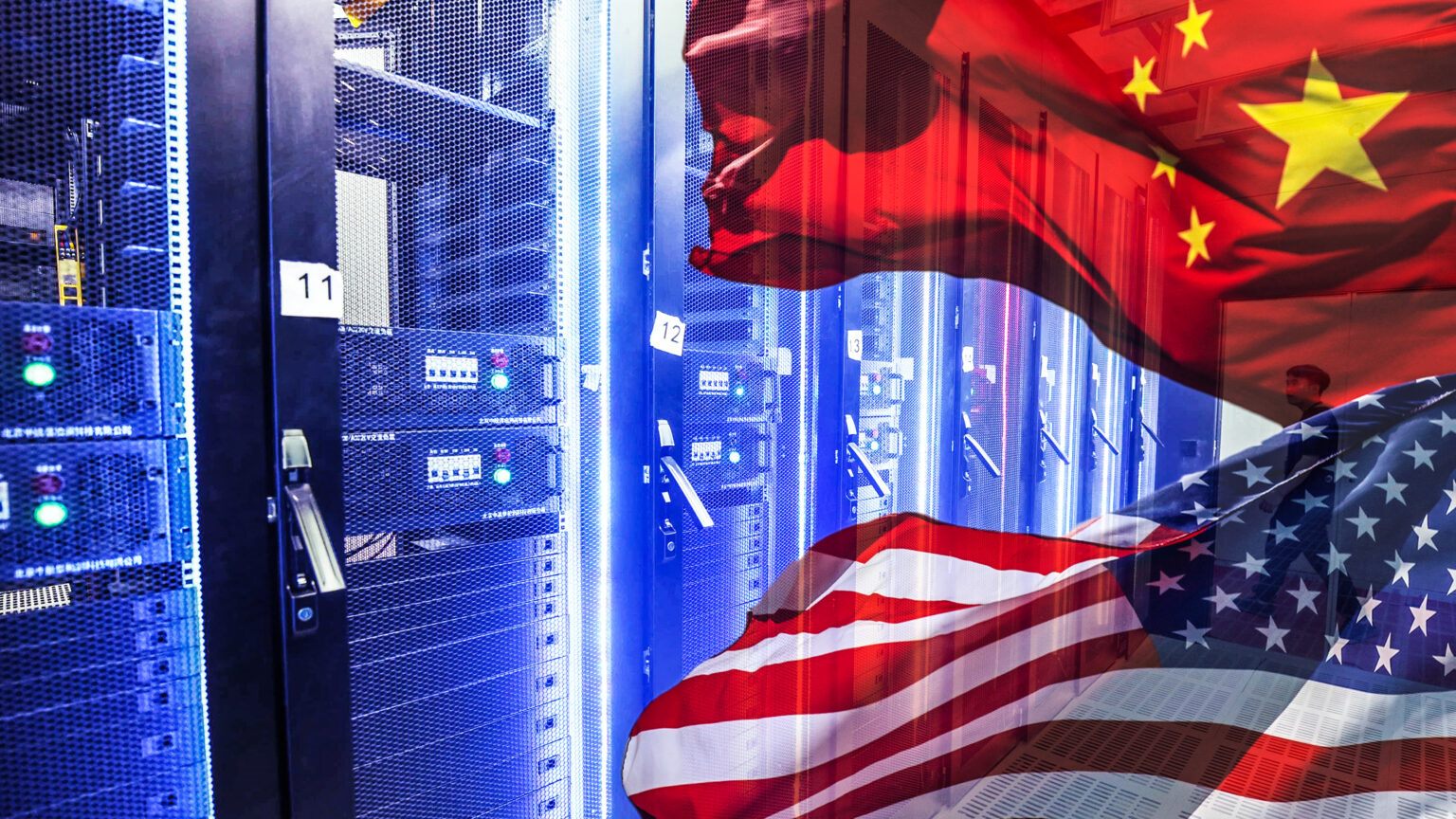
Nations have always competed over the technology that defines an era — gunpowder, railways, the atom, the microchip. The claim now gaining ground in Washington and Beijing is that artificial intelligence is the next such technology, and that whoever leads in it may gain a compounding advantage in both wealth and war. That belief is already reshaping policy. Since October 2022, the United States has treated the flow of advanced AI chips the way earlier eras treated warships or enriched uranium: as a strategic resource to be counted, controlled, and denied to a rival.
The question this forecast weighs is not whether AI will be useful — it plainly will — but whether it becomes the organizing axis of great-power competition, the way the nuclear balance organized the Cold War. If it does, the coming decade will be defined less by tanks and treaties than by chips, data centers, and the algorithms that run on them. We assess this is the most likely path, and this piece explains why, and where it could still bend.
What the Evidence Shows
The clearest evidence is that governments are already behaving as if AI is a strategic prize. In October 2022, the US Bureau of Industry and Security barred the export of the most powerful AI chips — Nvidia's A100 and H100 — to China. When Nvidia designed slightly slower China-specific versions, the H800 and A800, those were banned too, in October 2023. The rules were tightened again through 2024 and 2025, and in January 2025 an "AI Diffusion" framework proposed sorting the entire world into tiers based on how freely each country could buy American chips. The unit of competition, in other words, has become "compute" — the sheer number of advanced chips a nation can marshal.
China has responded by pouring resources into home-grown compute, leaning on firms like SMIC for fabrication and Huawei's Ascend processors for AI work. Then, in early 2025, a Chinese lab called DeepSeek released a model that performed near the global frontier while apparently using far less computing power than Western rivals assumed necessary. It rattled financial markets and made a sharp point: clever algorithms can partly substitute for raw hardware, meaning export controls slow a rival but may not stop one. Meanwhile, capital is flooding in — the roughly $500 billion "Stargate" data-center plan announced in January 2025 signals the scale now considered normal.
"Advanced AI systems could reshape the balance of economic and military power; the states that lead may find their advantages compound over time."
— Themes drawn from CSIS and CNAS analysis of AI and national competitiveness, 2024–2025The military dimension is no longer hypothetical. Ukraine's battlefields have proven cheap autonomous and semi-autonomous drones at scale, AI is being folded into targeting and decision-support systems, and the US Department of Defense launched its "Replicator" initiative to field masses of low-cost autonomous systems quickly. At the same time, a United Nations expert group has debated lethal autonomous weapons for years without agreeing on any binding limit. The tools are arriving faster than the rules that might govern them.
"The new unit of national power is compute — measured not in warheads or carriers, but in chips."
Why This Is Happening
AI is a "general-purpose" technology, and those reshape power. Like electricity or the computer, AI is not one product but a layer that improves almost everything built on top of it — logistics, biology, code, surveillance, weapons. A lead in a general-purpose technology tends to widen rather than fade, because early advantages fund the research that produces the next advantage. That is why both capitals treat a rival's progress as a threat rather than a curiosity.
Compute is scarce, physical, and chokeable. Unlike software, the most advanced chips can only be made through a supply chain with a few narrow choke points, which makes them controllable in a way that ideas are not. Export controls work precisely because you cannot download a chip fab. This hands governments a lever they rarely have over fast-moving technology — and once one power pulls that lever, the other must respond, entrenching AI as the field of contest.
The military stakes make hanging back feel dangerous. Deterrence logic pushes every major power to assume a rival will militarize AI, so none feels safe pausing. Autonomous systems promise faster decisions and cheaper mass; whoever hesitates risks being outpaced. With no binding international limits in sight, the safe-seeming choice for each side is to keep pushing — which locks the rivalry in.
What Could Happen
Export controls and subsidies continue, China narrows the gap through efficiency and domestic chips without fully closing it, and both powers race on frontier models and military autonomy. Rivalry is intense but stops short of open conflict, with AI clearly the defining strategic contest of the decade.
A scare — a serious autonomous-weapons incident or a near-miss — pushes the powers toward narrow risk-reduction understandings, even as the underlying competition continues. AI remains central, but with a thin layer of agreed limits, much as arms control once overlaid the nuclear race.
A crisis over Taiwan, a major war, or an economic shock reorders priorities so that AI becomes one tool among many rather than the organizing contest. Progress could also plateau, cooling the sense that leadership confers a decisive edge.
What Can We Do
AI policy can feel remote, decided by governments and a handful of very large companies. But it touches ordinary life fast — through jobs, information, and security — and informed publics shape how it is governed.
Learn the basic vocabulary. Understand what "compute" means, why advanced chips matter, and the difference between a model that assists a human and one that acts on its own. These few concepts cut through most of the hype and let you judge claims on their merits rather than their volume.
Follow the credible trackers. The Stanford HAI AI Index, CSIS, CNAS, and Brookings publish measured, sourced analysis of AI capabilities and policy. Watching these beats reacting to whichever demo or scare is trending on a given week.
Ask for accountability on autonomous weapons. The debate over lethal autonomous systems is happening now, largely out of public view. Supporting transparency and meaningful human control over the use of force is a concrete, non-partisan ask that citizens can press for regardless of which country leads.
Keep the economic stakes in view. AI's rivalry is not only about weapons; it is about who builds the tools that raise productivity and living standards. Backing education, research, and competition — rather than only restriction — is how societies stay in the race rather than merely fear it.
- US Bureau of Industry and Security — Advanced Computing Export Controls, 2022–2025
- Stanford HAI — Artificial Intelligence Index Report, 2025
- CSIS Wadhwani AI Center — AI and National Competitiveness, 2024–2025
- Center for a New American Security (CNAS) — AI and Autonomy Research, 2024
- Brookings Institution — Governing Artificial Intelligence, 2025
- Forecast The World Research Desk — 800+ data sources